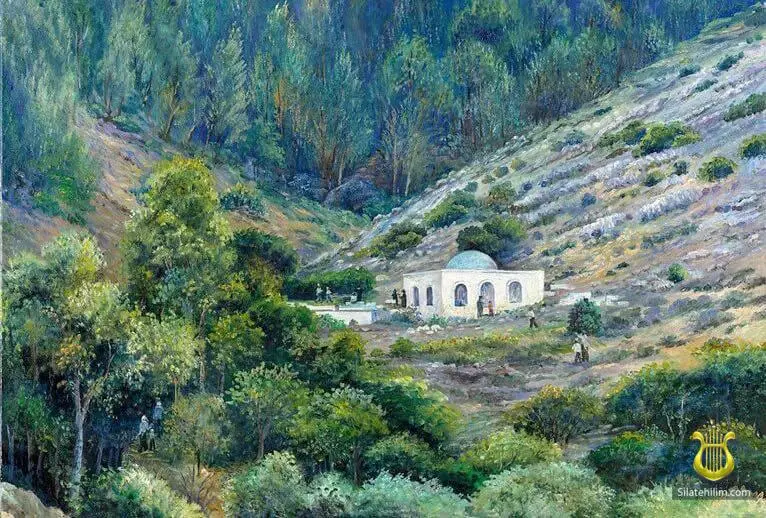
26 Sivan: Yahrzeit of Rabbi Yonatan ben Uziel—a Segula in Amuka
26 Sivan: Yahrzeit of Rabbi Yonatan ben Uziel—a Segula in Amuka
On 26 Sivan and 15 Av, many people hurry to the grave of Rabbi Yonatan ben Uziel—the greatest of the righteous, who bestows blessings for a good shidduch.
Yonatan ben Uziel (may his merit protect us) was said to have been so inspired while studying Torah that birds flying above him were consumed by the flames of his inspiration. (Sukkah 28) This means that anyone who attempted to refute his halachic teachings would not succeed.
Rashi also wrote that angels would come especially to hear the words of his Torah teachings.
The translation of the Five Books of the Torah was produced by the convert Onkelos, based on the teachings of Rabbi Eliezer and Rabbi Yehoshua, while the translation of the Prophets was produced by Yonatan ben Uziel, based on the teachings of the prophets Haggai, Zechariah and Malachi.
When this translation appeared, the Holy Land trembled for 400 parasangs in length and 400 parasangs in width, and a Bat Kol was heard:
— “Who is the one who dared reveal My secrets to mankind?”
Yonatan ben Uziel arose and said:
— “I am the one who revealed Your secrets to mankind. But You, L-rd, know that I did this neither for my own honor nor for the honor of my family, but for the sake of Your glory, L-rd, so that disputes would not multiply among Israel.” (Megillah 3)
He also wanted to translate the Writings into Aramaic, but then a Bat Kol said: “Enough!”
Heaven prevented him from revealing the secrets of the Final Redemption.
He lived several decades before the destruction of the Second Temple and was one of the 80 Tannaim—the disciples of Hillel the Elder:
30 of them were worthy of the Divine Presence resting upon them, as it did upon Moshe Rabbeinu;
30 of them were worthy of having the sun rise for them, as it did for Rabbi Yochanan ben Zakkai. (Bava Batra 134a)
Yonatan ben Uziel is known as the author of the book “Targum Yonatan”.
He also wrote a Kabbalistic book known as “Megadnim”.
According to an entry in a scroll discovered from the 11th century, his grave is located in Mitzpe Amuka, near Safed, in northern Israel.
Why Amuka
Interestingly, until 1985, the grave of Rabbi Yonatan was neglected and not very popular, until the following story took place.
In 1985, Venetia Shavua, a resident of the village of Amnon near Lake Kinneret, had a dream in which Rabbi Yonatan appeared to her and promised to heal her younger son, who was hospitalized at the time with a serious illness. The next morning, when she arrived at the hospital, she saw that her son had recovered as if by magic.
In gratitude, Venetia vowed to restore the tzadik's grave. From that moment on, she began cleaning and maintaining it, attracting the attention of inspectors from the Ministry of Religious Affairs (the department responsible for protecting the graves of tzadikim and holy sites) and the local municipality. This led to the construction of a road and the improvement of the site.
At every official body, Venetia told the story of her son's miraculous healing. Numerous stories of successful matches attracted even more people to the site, which led to its further development and improvement.
Venetia passed away, but her son and daughter-in-law continue the work she began.
In 1987, renovation work revealed that the monument stood on a sarcophagus.
Traditionally, unmarried women and men visit this site in the hope that prayer there will help them find their soulmate.
26 Sivan is the hilula (memorial day) of Rabbi Yonatan ben Uziel.
He entered the World of Truth unmarried, never having fulfilled the mitzvah of “Be fruitful and multiply”, and therefore, before his death, he promised that if a person who was unable to establish a family came to his grave with a prayer, he would help him.
By tradition, women ascend to the roof of the tomb and circle its blue dome seven times while reciting one of the psalms of King David (Psalm 29 and the prayer “Ana BeKoach”). Seven times, because when the Temple stood in Jerusalem, the priests would circle the altar seven times clockwise between the rituals.
It is also meritorious to recite the prayer “Nishmat Kol Chai” at the grave of Rabbi Yonatan ben Uziel, for it was with this prayer that Yitzchak prayed both for Rivka and for children.
Limud:
Yosef HaTzadik merited miraculous rescue from the schemes of Potiphar's wife through fire (light). The “Targum Yonatan” relates that Potiphar's wife spilled egg white on the bed in order to support her accusation that Yosef had attempted to assault her. Rabbi Yonatan writes in his commentary on the pasuk, “Look, he brought us a Hebrew man to mock us” (Bereishit 39:14): the word “look” is written ראו —and afterward this was examined with fire, ואר, revealing her lie, and Yosef was not killed. Regarding this it is said (Tehillim 94:11): “Or zarua la-tzadik” (light is sown for the righteous)—זרוע (sown)—read, by rearranging the letters, as עוזר (helps). “The righteous” refers to Yosef, who is commonly called צדיק (righteous).
May the zechut of Rabbi Yonatan ben Uziel protect our entire people!
(Tzadikim.com)
Was this helpful?
100% of readers found this article helpful (36 votes).
Please note: some articles on our site contain the holy Names of the Almighty. If you print these articles, they may not be thrown away or destroyed. Please handle printed copies with care and respect.
Material from our site may be copied for the purpose of spreading Torah, provided a link to Silatehilim.com is included. Any use of the site's material in print publications or for commercial purposes is prohibited without the rights holder's consent.